Hermann Borchardt – Edition of Works
Since 2021, the works of German-Jewish writer Hermann Borchardt (1888–1951) are being published by Wallstein as an annotated five-volume edition. This edition includes unpublished works from Borchardt’s papers, some of which were believed to be lost. The third volume, which introduces Borchardt’s second novel Geschichte einer Edelfrau (Tale of a Noblewoman) for the very first time, was prepared at the ZfL.
Bertolt Brecht once introduced Borchardt as the “greatest German-language satirist alive.” He could have just as easily described him as the least fortunate German writer in exile. In Germany, Borchardt had published three plays while also working together with Brecht on works such as Saint Joan of the Stockyards. However, after emigrating, he soon fell into obscurity. He was overlooked for decades in the research on exile literature and has only recently been rediscovered. His novel Die Verschwörung der Zimmerleute (published in English in 1943 as The Conspiracy of the Carpenters) was the only work by Borchardt published in Germany since the author’s emigration. This occurred only in 2005, when Uta Beiküfner published an edition of the novel taken from Borchardt’s literary estate. Unlike his significantly more famous friend Brecht, from whom he grew apart politically in exile, Borchardt was not only an opponent of German Nazi fascism, but also of Soviet communism. He had already begun to speak of a totalitarian rule in the late 1930s, long before Hannah Arendt came forward with her systematic critique of totalitarianism.
Borchardt was born in Berlin in 1888 as Hermann Joelsohn. He took on his mother’s name due to the palpable rise of antisemitism, even before 1933. During the Weimar Republic, he worked as a high school teacher. His first plays, which he wrote alongside his day job, were published by publishing house S. Fischer’s theater department. However, they were never staged. In April 1933, after being denounced by a colleague, he was forced to leave Germany. He initially fled to Paris before leaving for Minsk in the Soviet Union in 1934, where he accepted a position as a professor of German. When, in 1936, he refused to assume Soviet citizenship, he was expelled from the country. He returned to Berlin and was arrested shortly thereafter. A one-year imprisonment at the concentration camps Esterwegen, Sachsenhausen, and Dachau left him almost deaf and maimed in one hand due to severe torture and mistreatment. In 1937, he was able to emigrate to the United States thanks to the financial aid of Eva and George Grosz.
In New York, Borchardt led a shadowy existence as a writer. He managed to publish an abridged version of The Conspiracy of the Carpenters (with a foreword by Franz Werfel) with Simon and Schuster in 1943. Other than that, he only published a number of essays and pamphlets in which he dealt in particular with the threat of totalitarian rule. The plays he wrote in the US were neither printed nor staged, with the exception of Pastor Hall (1939). Although published under Ernst Toller’s name, the original version of Pastor Hall was ghost-written by Hermann Borchardt. Among the works he left behind, virtually unnoticed are Geschichte einer Edelfrau. Liebesroman aus deutscher Vergangenheit (Tale of a Noblewoman. A Romantic Novel from the German Past) and Traktat über die Unsterblichkeit (A Treatise on Immortality), which he was working on when he died.
Borchardt’s papers, which are by far the greatest part of his oeuvre, are one of the last almost untouched treasures of German exile literature from 1933 to 1945. It is the work of an author who went from sympathizing with communism to becoming a conservative critic, who denounced a world that had broken its greatest promises of happiness. Unfavorable historical circumstances have denied this versatile and highly original writer the appreciation he deserves. The circles of German émigrés to the US often looked favorably upon the Soviet Union from afar. Borchardt was a writer who had experienced both Bolshevism and National Socialism firsthand before becoming a staunch opponent of any form of totalitarian rule. He never stood a chance.
This edition brings together a representative selection of texts spanning four decades that reflect Borchardt’s intellectual and political development. Work on this edition began in 2019 at the Freie Universität Berlin with funding by the Fritz Thyssen Foundation. Since August 2023, this work is being continued at the ZfL, with funding by the Hamburg Foundation for the Advancement of Research and Culture.
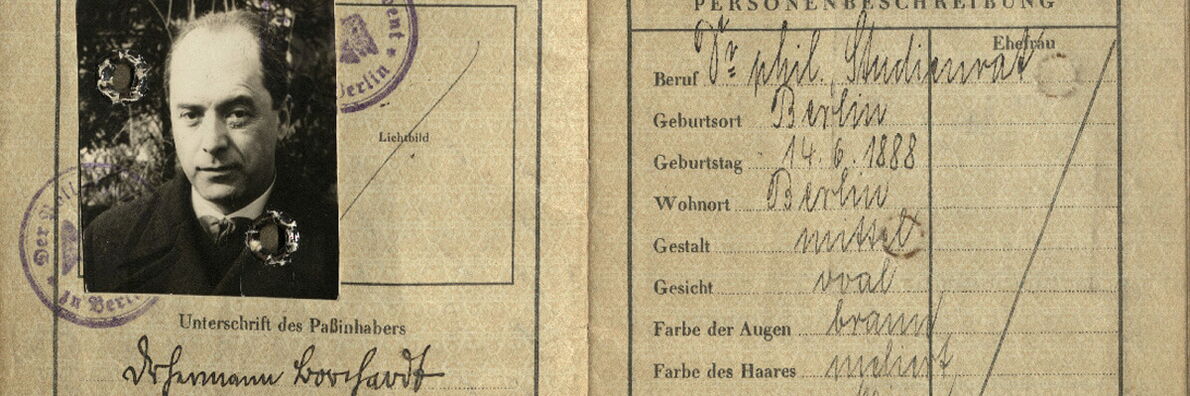
Fig. above: Hermann Borchardt’s passport, from the papers of Hermann Borchardt, Source: German Exile Archive 1933–1945 of the German National Library, Frankfurt am Main
2023–2024 funded by the Hamburg Foundation for the Advancement of Research and Culture since 2023
see also
Publications
Hermann Borchardt: Prosa
Edition schedule
Politische Schriften [Political writings]
Hermann Borchardt: Works vol. 4
Edited by Hermann Haarmann, Christoph Hesse, and Lukas Laier
Göttingen: Wallstein (expected in 2025)
Borchardt’s political writings span the broadest part of his lifetime. These include articles from his college time before the First World War, pamphlets from the time of the November Revolution and the Weimar Republic, and finally the essays and brochures he wrote in American exile. An especially interesting contribution is Borchardt’s reflection on the “totalitarian state” which he already described as such in the late 1930s. From that point onward, the former socialist and anarchist became not only an advocate for individual freedom, but also a Christian author with an ironic take on the popular vilification as “reactionary.” Already in 1919, Borchardt criticized the leaders of the Communist Party as power-hungry demagogues. During his time in the Soviet Union, at the latest, he realized that Communism does not abolish inequality, but freedom; not poverty, but wealth. After the end of World War II, Borchardt appeared as a “German teacher,” addressing not only the American public, but also the Germans—whom his appeal most certainly did not reach. These political-educational works include numerous manuscripts of speeches and radio features on the “reeducation” of Germany.
Philosophische Schriften [Philosophical writings]
Hermann Borchardt: Works vol. 5
Edited by Hermann Haarmann, Christoph Hesse und Lukas Laier
Göttingen: Wallstein (expected in 2026)
This volume centers on the Traktat über die Unsterblichkeit (A Treatise on Immortality), an unfinished work that Borchardt began in 1946 and which can be viewed as the author’s legacy. “As authors did in medieval times,” he sent the “consoling 9th chapter” of his tract to his good acquaintance Hermann Hesse. Other than him, however, this work had almost no readers to this day. In his philosophical-literary opus magnum spanning over 700 typewritten pages, Borchardt, applying both a didactic as well as a sarcastic, but always an upbeat narrative tone, tackles the ideological framework of the modern world: materialism, scepticism, relativism, to name only a few key concepts. Additionally, the volume will include shorter philosophical essays as well as manuscripts for lectures Borchardt was meant to give at the Université Laval in Québec in 1950, an endeavor which his deteriorating health would no longer allow for.
Previously released volumes of the edition
Autobiographische Schriften [Autobiographical writings]
Hermann Borchardt: Works vol. 1
Edited by Hermann Haarmann, Christoph Hesse, and Lukas Laier
Göttingen: Wallstein 2021, ISBN 978-3-8353-3864-7, 359 pages.
Among the personal testimonies collected here, this volume centers on the so-called “Lagerbuch” (camp book) in which Borchardt describes experiences and observations he made during his imprisonment in German concentration camps. This work, which was written in 1938 in the USA and only passed on in fragments, was at best heard of by hearsay. Now, as these chapters and fragments are published for the very first time, they offer an early historical document of a “camp literature” that was only just emerging at the time. With his uncompromising account, Borchardt counters the idea of prisoners joined in solidarity, a widespread notion among political journalists of the time.
Furthermore, this volume features notes on Bochardt’s years in the Soviet Union from 1934 to 1936. Early on, the material misery he witnessed there as well as the omnipresent fear of denunciation and arrest, including reports he received of the current famine resulting from “collectivization,” led the former socialist to write an outrageously radical critique of Soviet “state slavery.” It is a macabre feat of irony that Borchardt escaped Stalin’s terror in 1936 by “fleeing into German concentration camps.” Nevertheless, the volume is opened by a somewhat cheerful if occasionally melancholic text: Der Club der Harmlosen (The Club of the Harmless), a novel introduced as a “true story” from Borchardt’s life which he began writing in the mid-1940s. In it, he looks back on his childhood in Wilhelmine Berlin.
Stücke [Plays]
Hermann Borchardt: Works vol. 2
Edited by Hermann Haarmann, Christoph Hesse, and Lukas Laier
Göttingen: Wallstein 2022, ISBN 978-3-8353-5134-9, 687 pages.
Borchardt’s dramatic works include the plays published by S. Fischer’s theater section in the years 1928/29 which were not available since as well as the plays written during Borchard’s exile in the USA which he was never able to publish himself. Most of these works edited from his estate deal with the Christian resistance against National Socialism with a special focus on the imprisonment in a concentration camp. This includes Befreiung des Pfarrers Müller (Pastor Müller’s Redemption) from 1938, an unfinished play passed down in three acts. A year later, Ernst Toller based his famous drama Pastor Hall (1939) on Borchardt’s play. The “Urschrift” (original script), as Borchardt himself called it, is published in this volume for the very first time. It proves the scope in which Toller adapted elements from this original source without ever mentioning it.
Christoph Hesse
- Kein “so normaler Liebes-Roman”: Zur Geschichte der “Geschichte einer Edelfrau”, in: Hermann Borchardt: Werke, vol. 3: Prosa, ed. by Hermann Haarmann, Christoph Hesse, and Lukas Laier. Göttingen: Wallstein 2024, 548–564
- Hermann Borchardt, der “Unterirdische”. Vom Mitarbeiter Brechts zum Ghostwriter Tollers, in: Lydia Mühlbach, Kirsten Reimers, Thorsten Unger (eds.): Bertolt Brecht und Ernst Toller. Stuttgart: Metzler (forthcoming) (with Lukas Laier)
Lukas Laier
- Hermann Borchardt, der “Unterirdische”. Vom Mitarbeiter Brechts zum Ghostwriter Tollers, in: Lydia Mühlbach, Kirsten Reimers, Thorsten Unger (eds.): Bertolt Brecht und Ernst Toller. Stuttgart: Metzler (forthcoming) (with Christoph Hesse)
- Edieren aus dem Nachlass, in: ZfL Blog, 6 Nov 2023