Notes and Queries on Anthropology. On the Transformation of Documentary Evidence in Anthropology
The emergence of modern anthropology in the early 20th century is commonly associated with the methodological paradigm of participant observation, epitomized by the work of Bronisław Malinowski. In Britain and beyond, this narrative was vigorously promoted by Malinowski’s students, who built their careers on the premise that professional anthropology required firsthand experience in the field. While recent scholarship has challenged this narrative, an important component of pre-Malinowskian fieldwork remains insufficiently examined: the institutionalized and methodologically sophisticated data collection practices that flourished under what I call the questionnaire method. Contrary to later claims by professional anthropologists, who dismissed such research practices as “armchair anthropology,” late Victorian ethnography was underpinned by a rigorous and institutionalized observational protocol. A key milestone in this development was the publication of Notes and Queries on Anthropology, for the Use of Travellers and Residents in Uncivilised Lands by the British Association for the Advancement of Science in 1874. This manual contained a detailed questionnaire—divided into more than 100 sections each containing up to 100 questions—designed to standardize the collection of ethnographic data across the British Empire.
The project aims to reassess this foundational moment by foregrounding the questionnaire method as a historically distinct and consequential mode of fieldwork that not only preceded participant observation but also fundamentally shaped the formation of anthropological knowledge of non-European societies. By tracing the genealogy of anthropological data collection, it illuminates how documentary evidence—codified in questionnaires like Notes and Queries—served as a precondition for the modern ethnographic encounter.
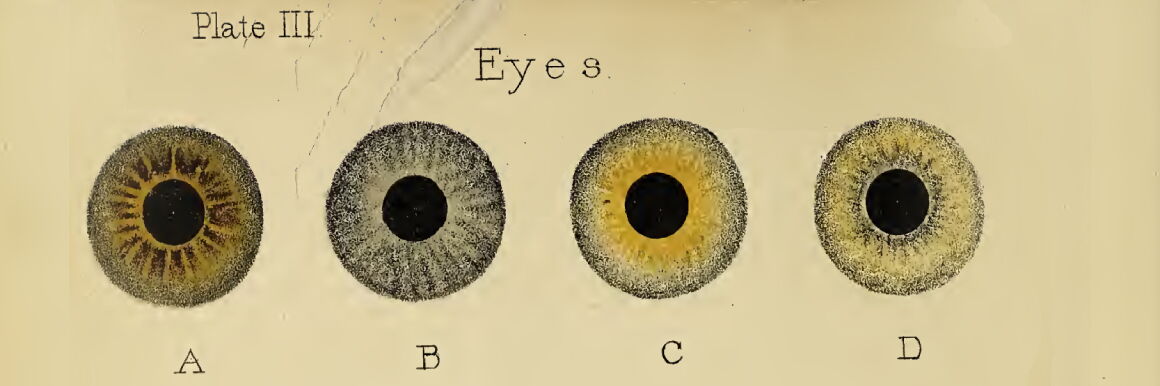
Fig. above: Comparison stencils for determining human eye color, Source: John George Garson, Charles Hercules Read: Notes and Queries on Anthropology. Third Edition, edited for the British Association for the Advancement of Science. London: The Anthropological Insitute 1899, 17
2025 funded by the Leibniz Research Alliance “Value of the Past”
2025–2026