Strategies of Critique. A Systematic Reconstruction of the Debate on documenta fifteen
The fifteenth edition of documenta, held in 2022, saw accusations of anti-Semitism brought against the curating collective ruangrupa and various exhibits, leading to a heated public debate in Germany. This debate, in turn, became a cultural-political event with global repercussions.
The project aims to explain the fierceness of the controversy, whilst simultaneously recovering the debate as an at times productive argument from which much can be learned. To this end, the project will reconstruct the course of the debate as it unfolded in German newspapers and on Twitter, focusing in particular on how criticism was expressed: How did various speakers pass judgments, make distinctions, and invoke rights, norms, and opposing viewpoints? In doing so, the project takes up a reflexive stance that was already prevalent in the debate—namely, an awareness of the fact that criticism was exercised strategically, that it was systematic, interest-driven, and aimed at taking effect. In other words, that criticism in this debate did not follow a deliberative logic, but a polemical logic and may not have actually said what it meant. For example, accusations were leveled that criticism of Israel spread anti-Semitism in coded or indirect ways. Conversely, these accusations were themselves accused of being strategically aimed at suppressing legitimate criticism of Israel.
By seeking to empirically capture the strategic orientation of critical practices, this project introduces a new approach to researching criticism in the humanities and social sciences and brings it into dialogue with anti-Semitism studies. It also examines whether the development of this controversy reflected a fundamental problem of strategically oriented criticism within liberal public spheres. Rather than reflecting a specifically German approach to addressing anti-Semitism or merely resulting from polarization dynamics driven by social media, the controversy may reveal broader tensions within liberal public spheres. The perception that criticism is being exercised strategically appears to engender particular dynamics of debate that conflict with the ideal of a reasoned public exchange of opinions that underpins liberal society. Since the expression of opinions that might covertly spread anti-Semitism is largely protected under freedom of speech and artistic freedom, it can provoke a potentially equally strategic “counter-critique” that employs liberal ideals—such as individual freedoms, open discussion, or universalism—for its own purposes.
This project thus renders the examination of strategies of critique a central component of a comprehensive historicization of the documenta debate, whose internal dynamic generated reflexive knowledge about its contentious issues. It thereby captures recurring forms of critique and contributes to opening a conceptual space in which different trajectories of debate are rendered possible in the future.
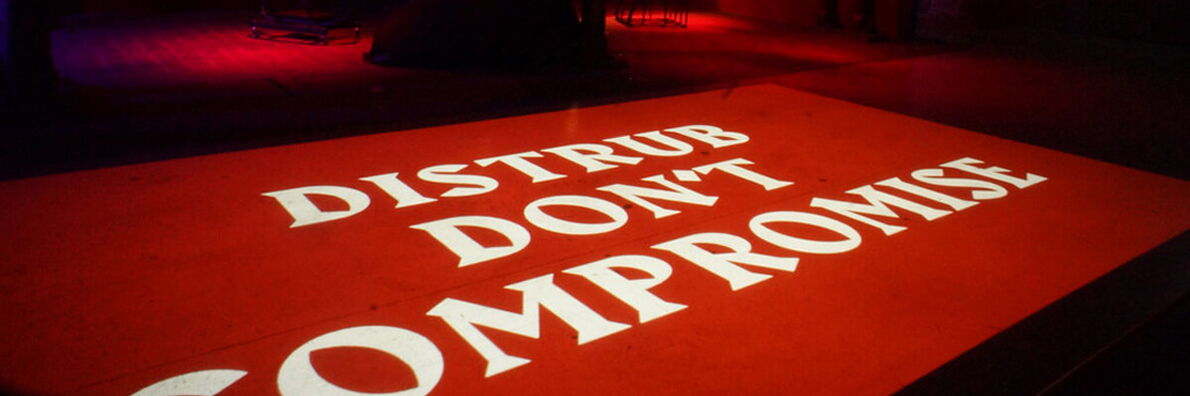
Fig. above: Party Office ib2b Fadescha: “Don’t Disturb Don’t Compromise”, source: Seen at the documenta fifteen by Ephemeral Impressions, licence: CC BY-SA 2.0.
Publications
Georg Simmerl
- Polemische Expertisen. Über die (Un-)Möglichkeit einer wissenschaftlichen Aufarbeitung des Antisemitismusskandals auf der documenta fifteen, in: zeitgeschichte-online, 10 Apr 2025