Call for Papers: Benjamin’s Animals. Figurations of Animality
Benjamin’s Animals. Figurations of Animality
Workshop, 3–4 December 2026, Leibniz-Zentrum für Literatur- und Kulturforschung (Berlin)
Organizers: Daniel Gönitzer (University of Vienna) & Melanie Konrad (Vienna)
The workshop is funded by the “Walter Benjamin Prize for Early Career Researchers” and supported by the Walter Benjamin Archive (Berlin), the Leibniz-Zentrum für Literatur- und Kulturforschung (Berlin) and the International Walter Benjamin Society.
****
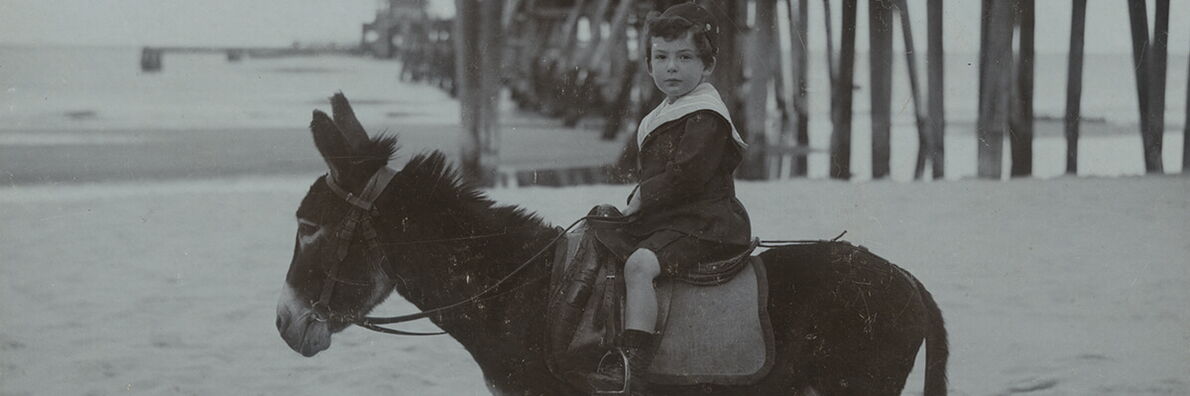
While there is only a single photograph that shows Walter Benjamin with an animal, showing the four-year-old riding a donkey in Heringsdorf in 1896, animals appear in his writings with striking persistence and in great variety. They emerge as childhood playmates, as hybrid beings at the thresholds of human identity, perception, and imagination, as ironic counter-images to technological progress, as media figures, and as melancholic companions of historical consciousness. Despite this abundance, Benjamin’s engagement with animality has not yet been mapped as a coherent field. The workshop aims to examine the figures, constellations, and movements of thought connected to animality, and to explore the role of the animal as an epistemological and poetological figure in Benjamin’s work.
Benjamin’s early observation that children are far more drawn to speaking and acting animals than to moralizing texts points to a form of knowledge beyond didactic discipline. From Bertuch’s Bilderbuch für Kinder, through Benjamin’s studies on children’s literature, to his radio work, one thing becomes clear: animals mediate playful cognition. In Berlin Childhood, butterflies, dogs, and otters mark thresholds of perception, sites of uncertainty and productive irritation where the worlds of objects, fantasy, and experience interpenetrate.
Elsewhere, animal figures act as agents of critical sensibility. In One-Way Street, Benjamin speaks of animals’ “dark instinct” for finding escape routes in moments of danger. This image serves as a countermodel to rationalized perception and as a metaphor for a defiant presence of mind. Benjamin’s encounters with hybrid beings, which blur the boundary between human and animal, are particularly revealing. The eccentric animal–human figures of J. J. Grandville and the disfigured creatures of Franz Kafka undermine stable notions of identity and model transformation as a form of thought.
Benjamin’s engagement with animals in contemporary media also deserves special attention, from zoo animals that become “speaking” through Kasperl’s translational work, to early Mickey Mouse cartoons. In the transgression of bodily boundaries, Benjamin discerns both the destructive force of modern technology and its utopian comedy, the possibility of ironizing the human without negating it.
Finally, in The Origin of the German Trauerspiel, animals appear in the form of the “Saturn animals” as a melancholic allegory of the historical process. They represent the enigmatic, the veiled, the forgotten, thus embodying Benjamin’s engagement with historicity.
Benjamin’s writings are full of animal figures that function as epistemic agents. They structure his reflections on perception, technology, history, and language. This interlacing of aesthetics, anthropology, and media reflection makes him a key author for interdisciplinary debates. Animal studies, ecocriticism, and posthumanism all seek alternative models of subjectivity, relationality, and mediality. Benjamin, without being a posthumanist himself, offers theoretical resources and concepts: creatureliness, mimicry, distinctions between human and divine language, non-anthropocentric models of perception.
The workshop seeks to determine whether this line of thought can be substantiated. We invite contributions that address, among others, the following questions:
- In what ways do animal figures, and does animality, fulfill epistemic functions in Benjamin?
- How do animal figures act as markers of play, danger, mediality, or melancholy?
- What perspectives does a concept of animality in Benjamin open up for current research increasingly engaged with animal studies, ecocriticism, media anthropology, and posthumanism?
The workshop is designed for 12–15 participants. Both days will include panel discussions, group readings of Benjamin’s works, and other activities. To ensure the workshop-like atmosphere of the event, the focus will be on group discussions.
Interested individuals are invited to submit proposals for short presentations (15–20 minutes) in the form of a brief thematic outline (approx. 300 words) and a short biography (max. 150 words) by 31 May 2026, to daniel.goenitzer@univie.ac.at and melanie.konrad@protonmail.com.
Presentations can be given in German or English; the working language is German. Please indicate in your submission whether you require support for travel expenses.
Fig. above: Akademie der Künste, Berlin, Walter Benjamin Archiv, WBA 1498; Hamburger Stiftung zur Förderung von Wissenschaft und Kultur.