Künste – Medien – Umwelt. Architekturtexte der österreichischen Neoavantgarde (1955–1975)
Since the mid-1950s, new forms of artistic expression have emerged in Austria, particularly in Vienna and Graz. These differ significantly from classical modernism in terms of both content and form. Writers rejected fictional and subjective approaches to reality, becoming interested instead in the auditory and visual dimensions of texts. Similarly, architects no longer wanted to limit themselves to creating functional and utilitarian living and working spaces, but also sought to transform the environment through the use of new media, materials and technologies.
These innovations drew on anti-bourgeois traditions. Notably, these included the historical avant-garde movements, such as Futurism, Dadaism, Surrealism and Constructivism, which aimed to bring art into everyday life, as discussed in Peter Bürger's influential 1973 text Theory of the Avant-Garde. Therefore, we would prefer to speak of an Austrian Neo-Avant-Garde rather than resorting to terms such as “Postmodernism” or, more specifically, the “Austrian Phenomenon” (a term first used by Peter Cook in his 1970 book Experimental Architecture).
The purpose of our conference is to discuss the innovations of the Austrian Neo-Avant-Garde from historical and aesthetic perspectives, and to redefine them if necessary. As a guiding principle, we propose the concept of the architectural text. This should consider both creative innovations and the fact that literary and visual forms usually went hand in hand in disseminating ideas. We plan to publish the conference contributions based on our edited volume on the interrelationships between literature, architecture, urban planning and interior design in Vienna between 1900 and 1930: Planen – Wohnen – Schreiben. Architekturtexte der Wiener Moderne [Planning – Living – Writing. Architectural Texts of Viennese Modernism] (Vienna: Picus 2021).
Funded by the Cultural Department of the City of Vienna and the International Research Center for Cultural Studies (ifk) in cooperation with the Museum of Applied Arts Vienna (MAK), the University of Vienna and the ZfL.
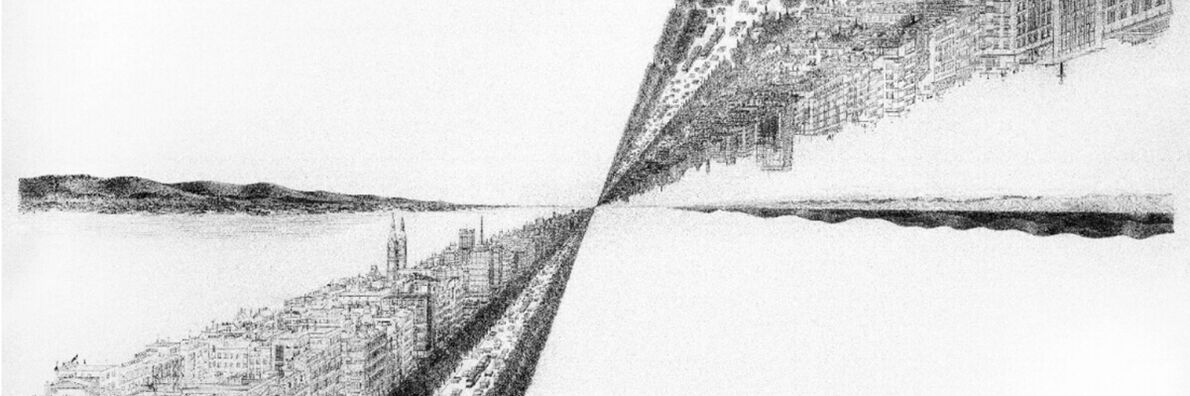
Fig. above: Max Peintner: Ein Vorschlag fürs Jenseits. Vienna 1971 (detail)
Program
9.00
- Welcome and introduction
9.15
- Detlev Schöttker (ZfL): Historische Avantgarde und österreichische Neoavantgarde
- Ákos Moravánszky (ETH Zurich): Rekonstruktionen der Wiener Moderne – Dialekte der Avantgarde
11.00
- Gabriele Kaiser (Vienna/Linz): Die Polemik des Manifests und die Sprache der Kritik
- Gerd Zillner (Austrian Frederick and Lillian Kiesler Private Foundation, Vienna): Manifeste, Mahnungen, Notizen – Friedrich Kieslers späte Texte über Architektur, die Künste und die Umwelt
13.30
- Thomas Eder (University of Vienna): …eine “quasi-räumliche” “Tendenz”. Zur Umwendung des Raumes in Texten, Poetologien und Theorien der Wiener Gruppe
- Roland Innerhofer (University of Vienna/ifk): “Abräumen von Sehgewohnheiten”. Friedrich Achleitner als Schriftsteller und Architekturkritiker
- Szilvia Gellai (University of Vienna): Textile Architekturtexte. Materialstudien zu Hans Holleins Medien
16.00
- Samuel Korn (University of Kassel): Bau. Schrift für Architektur und Städtebau. Das Material ist die Massage
- Sebastian Hackenschmidt (MAK): Ein Ende des Austrian Phenomenons: Der soziologische Turn der österreichischen Architektur in den 1970er Jahren
17.30
- Closing discussion