Composing Worlds: Anthropology, Ontology, and the Decolonization of Being
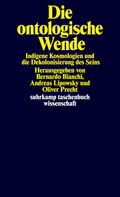
Presentation of Bernardo Bianchi, Andreas Lipowsky, Oliver Precht (eds.): Die ontologische Wende. Indigene Kosmologien und die Dekolonisierung des Seins (Suhrkamp 2026) with Bernardo Bianchi, Philippe Descola, Thomas Khurana, and Oliver Precht
The question of how to theoretically articulate and politically organize the differences between modern, Western cultures and the numerous non-modern cultures that today are often referred to as “Indigenous” is as old as anthropology itself. Over the past 30 years, a body of thought has emerged that speaks to this question by proposing the notion of a pluriverse. In other words, the idea that we inhabit a diversity of worlds grounded in different ontologies and natures. Such a reorganization of worlds demands a new form of “cosmopolitics.” If one follows the basic assumptions of this discourse, this politics requires a radical relativization or re-situating of the fundamental concepts of our Western-modern cosmology. In short, it requires a decolonization of being.
The recently published reader Die ontologische Wende aims to make this school of thought accessible to a wider German-speaking audience.
Drawing on the texts collected in the reader, this panel discussion will explore the complex of issues raised by this approach and their particular urgency in an era of climate crisis—a crisis that is also a crisis of the modern worldview.
Bernardo Bianchi is a philosopher and researcher at the Centre Marc Bloch in Berlin. His research focuses on political philosophy, intellectual history, Marxism, and Indigenous political thought.
Philippe Descola is Professor Emeritus of Anthropology at the Collège de France, where he held the Chair of Anthropology of Nature. In recognition of his groundbreaking work on the relations between humans and non-humans and his contribution to anthropology, he has received numerous distinctions, including the CNRS Gold Medal. He is a member of the British Academy and the American Academy of Arts and Sciences.
Thomas Khurana is Professor of Philosophical Anthropology and Philosophy of Mind at the University of Potsdam, where he directs the Center for Post-Kantian Philosophy. His research focuses on post-Kantian philosophy, philosophical anthropology, social and political philosophy, and Critical Theory.
Oliver Precht is a philosopher and researcher at Leuphana University of Lüneburg. He previously worked at the ZfL and the Centre Marc Bloch. His research focuses on political philosophy, French theory, political ecology, Indigenous cosmologies, and Brazilian literature.
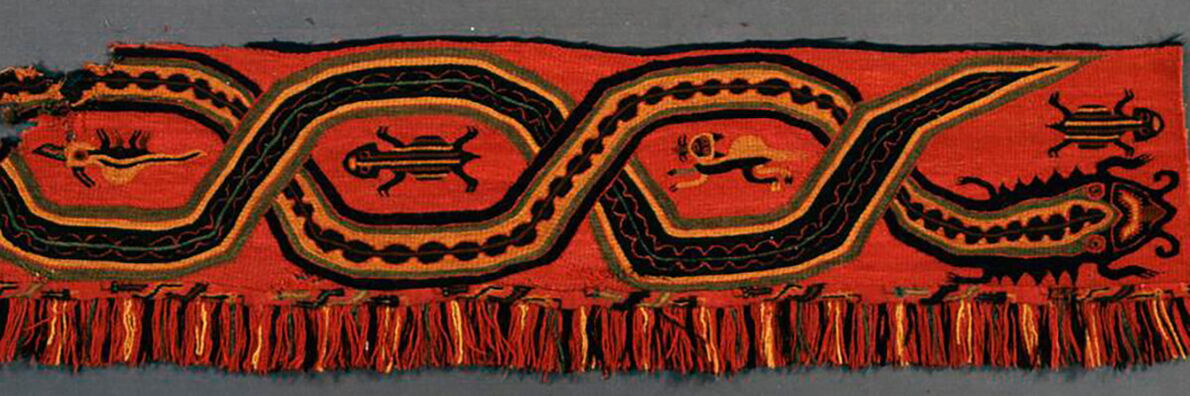
Abb. oben: Besticktes Baumwolltextilfragment mit verschlungenen Schlangenfiguren und stilisierten Tiermotiven aus der Nekropole von Paracas, Peru (1–500 n. Chr.) (Ausschnitt), © The Trustees of the British Museum, Lizenz: CC BY-NC-SA 4.0.
Publikationen