The Social Sublime in Nineteenth-Century German Literature
The prevailing reception of the literary period from E. T. A. Hoffmann to Thomas Mann frames German (poetic or bourgeois) realism as detached from the developing industrial and capitalist modernity that is paradigmatically associated with literary realism in England and France. This project challenges that view by examining the aesthetic responses and narrative modes produced by Germany’s late entry into modernity.
The project articulates the thesis that German Realism is driven by a strong desire to depict social totality. I suggest that realism does not merely depict existing social structures, but rather imaginatively and proactively creates them. Just as the cousin in E. T. A. Hoffmann’s Des Vetters Eckfenster imagines the future of German public life by observing market goers from his window, the works of Adalbert Stifter, Theodor Storm, Gottfried Keller, and Wilhelm Raabe also encourage us to envision a consciously united social totality, even though such a thing barely existed in reality. The literary depiction of mass social activities creates sublime impressions of a social whole that, whilst initially overwhelming, are then transformed into legible provisional social orders through narrative organization. Realistic prose thus generates ideas of social unity that are conditioned by aesthetics long before these became politically or institutionally available across the German states.
The absence of a consolidated national and socioeconomic order meant that German realists had to deploy the literary imagination to first conceive of a social whole, which was necessary for them to come to understand modernity. These texts can be said to operate in the mode of Kant’s reflective judgement, by first creating the general concept necessary to subsume observed social phenomena under a whole. From this perspective, these aesthetic innovations do not merely compensate for historical belatedness, but should be understood as critical interventions in which what is still missing is first aesthetically invented in the form of social imaginaries.
This reassessment of German Realism draws not only on Kantian aesthetics, but also on Hegel’s critique of the novel. In addition, it addresses later conceptualizations of social totalities developed by Ferdinand Tönnies, Max Weber, and Georg Simmel. The project thus understands German Realism not as the product of a deficient modernity, but as an independent aesthetic response to the challenge of rendering a social totality imaginable under modern conditions in the first place.
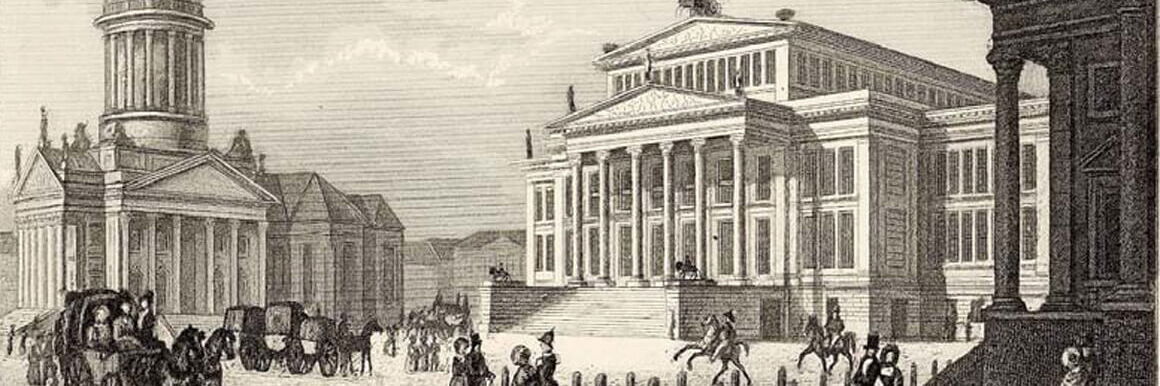
Fig. above: The New Church and Schauspielhaus in Berlin on a steel engraving by H. Fincke based on a drawing by W. Loeillot, published by F. Sala & Co. in Berlin (detail). Source: Gernot Ernst, Ute Laur-Ernst: Die Stadt Berlin in der Druckgrafik 1570–1870. Berlin: Lukas-Verlag 2009