The Anatomy of Indifference
In his 1903 essay Metropolis and Mental Life, Georg Simmel observes that “by establishing itself as the common denominator of all values, money, with its colorlessness and indifference, becomes the most terrible leveler, irretrievably hollowing out the core of things, their particularity, their specific value, their incomparability.” For Simmel, the objective indifference of money towards the specific qualities of things produces a subjective equivalent in the modern blasé attitude. Simmel describes the blasé attitude as both “the correct subjective reflection of a complete money economy” and as “indifference toward the distinctions between things.” Building on this diagnosis, this dissertation project has developed the concept of indifference in two ways: first, as the logical indifference of money, and second, as the physiological indifference of the blasé attitude. To this end, it has engaged with selected writings across Simmel’s oeuvre, from his 1890 work On Social Differentiation: Sociological and Psychological Investigations, through to his 1900 magnum opus The Philosophy of Money, to his final work on the View of Life (1918), published only a few months before his death.
The theory of indifference developed by Simmel is already latent in German philosophy as well as in Marxist thought. Here, it is structured by the dialectic between the two distinct German concepts of indifference: Indifferenz and Gleichgültigkeit. Whereas Indifferenz stems from the Latinate form of the ancient Greek word adiaphora (ἀδιάφορα) and signifies the negation or neutralization of the duality of difference, Gleichgültigkeit no longer denotes the negation of difference but rather its complete absence understood as the equivalence or equal validity of all things. Simmel not only shows how money and technology have historically contributed to the passage from Indifferenz to Gleichgültigkeit by increasingly mediating all aspects of everyday life. He also theorizes the subjective effects of this process on the individual as the affective condition of the blasé attitude. Both the transition from Indifferenz to Gleichgültigkeit and from overstimulation to the blasé attitude are driven by the economies of scale inherent to the mechanization and the globalization of labor processes.
Simmel thus illuminates the economic and technological bases of the phenomenon of indifference and connects them to the formation of an indifferent individual, whose world view is depleted of values and meaning. He thereby understands indifference as both an economic phenomenon—and thus societal and objective—as well as an individual and subjective phenomenon. Simmel’s theory continues to provide a powerful framework for critically reassessing contemporary conditions, especially in light of the accelerated processes of mediation brought about by an increased use of digital technologies and the growing interest in their desensitizing and immobilizing effects, manifest in conditions such as burnout.
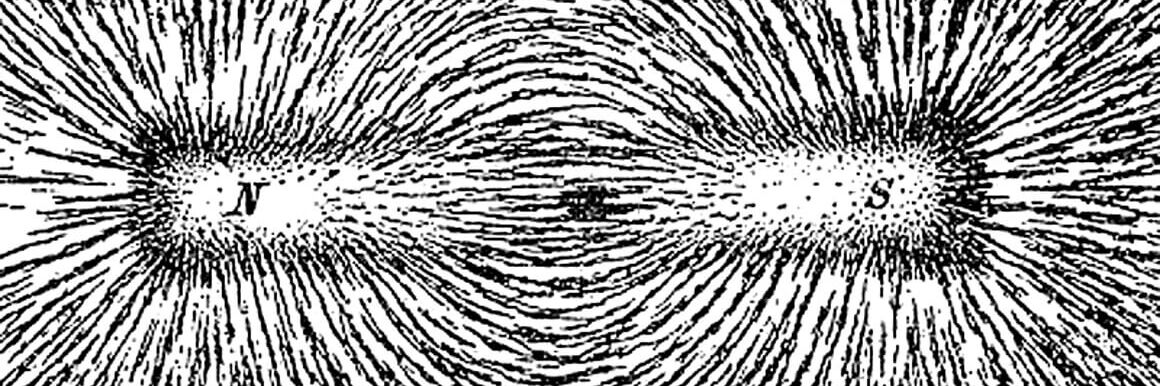
Fig. above: Visualization of the magnetic field of a bar magnet using iron filings, source: Wikimedia Commons, license: CC BY-SA 3.0