Medea street wide. Aby Warburg’s Pathos Formula Today
In his concept of the pathos formula (Pathosformel), the art and cultural historian Aby Warburg (1866–1929) articulated the observation that strong gestures, while unambiguous in their expressiveness, can be ambiguous in their meaning. They can therefore represent both the highest of triumphs and the deepest of sorrows. However, without an understanding of their context, the meaning of such gestures remains unclear. Even such contextual knowledge may not fully resolve their meaning.
This ambiguity becomes apparent when examining the recent political protests in Georgia, whose iconography can be traced back to the myth of Medea, who was from Colchis, now part of western Georgia. The project examined how ancient and later depictions of Medea are deployed in contemporary Georgian protest culture. It also considered the implications of these contemporary invocations of pathos formulas for Warburg’s theory.
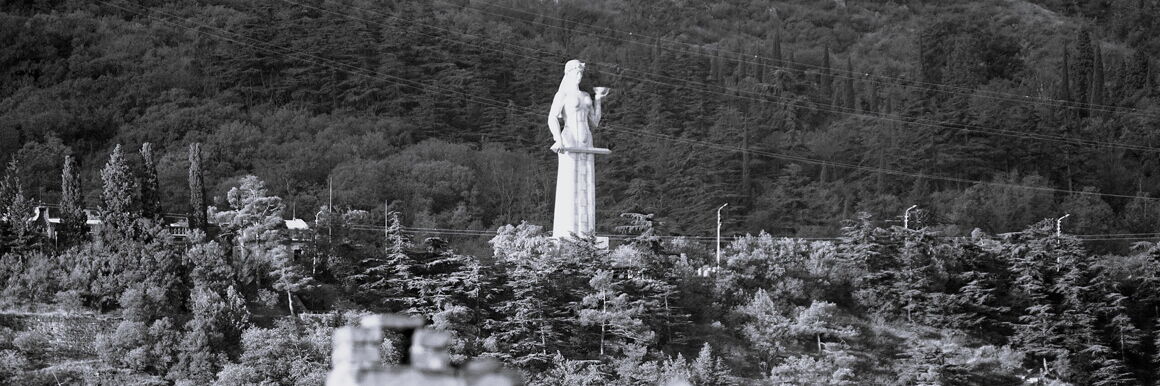
Fig. above: Statue of the “Mother of Georgia” in Tbilisi. Source: Wikimedia Commons, 三猎, licence: CC BY-SA 4.0
