Relational Inhabiting. Towards a Fisherman Ontology in modern Italian Art, Literature and Film
Fishermen communities are a challenging figure in modern Italian culture. Their transformation and gradual disappearance reveals the epistemic and socio-economic violence associated with modernization. Italian environmental historian Marco Armiero has recently diagnosed the “absence of the fishermen’s voice” from historical accounts, which is all the more astonishing for a country with such an extended coastline as Italy. They are also absent from influential philosophical explorations in which their presence might be expected, such as Hans Blumenberg’s Shipwreck with Spectator (1979).
In contrast, fishermen have figured prominently in Italian post-unitary art, literature and cinema, while challenging modernity’s very tenets. From paintings by Impressionst artists in the 19th and Realist artists in the 20th century, through novels and short stories such as Giovanni Verga’s I Malavoglia (1881), Giovanni Comisso’s Gente di mare (1929) and Stefano D’Arrigo’s Horcynus Orca (1975), and to films such as Luchino Visconti’s La terra trema (1948), Roberto Rossellini’s Stromboli (1950) and Gianfranco Rosi’s Fuocammare (2016), artisanal fishermen communities are shown to inhabit the coast’s liminal space between land and sea. Beyond the depiction of the clash between tradition and modernity, backwardness and progress, the past and the future, ‘primitive’ and ‘developed,’ these works provide a testimony of the way of life, beliefs, practices, knowledge, and understanding of the world of those communities. Artisanal fishermen communities are bearers, in the most literal sense, of what Édouard Glissant has called “archipelagic thought.” Their relational way of inhabiting the coastline connects animated and inanimated beings into a complex network of mutual dependence. Moreover, their constant movement of “departing-returning” opposes what sociologist Franco Cassano has described, in his book Southern Thought (1996), as the “oceanic lack of measure” of modern colonial endeavors.
My book will explore the figurations of artisanal fishermen communities in modern Italian art, literature and cinema from a critical anthropological, ecological, and decolonial perspective. Through a close reading that exposes these works’ ethnographic traces, I will outline a “fisherman ontology” that defies patterns of modern Western thought. My research aims at reconstructing the territorialization processes that Italy’s coastline underwent in its modern history, and offers new perspectives on current political and ecological crises. Finally, turning our attention toward fishermen communities enables us to move beyond national narratives and envision a comparative, global study of their figuration.
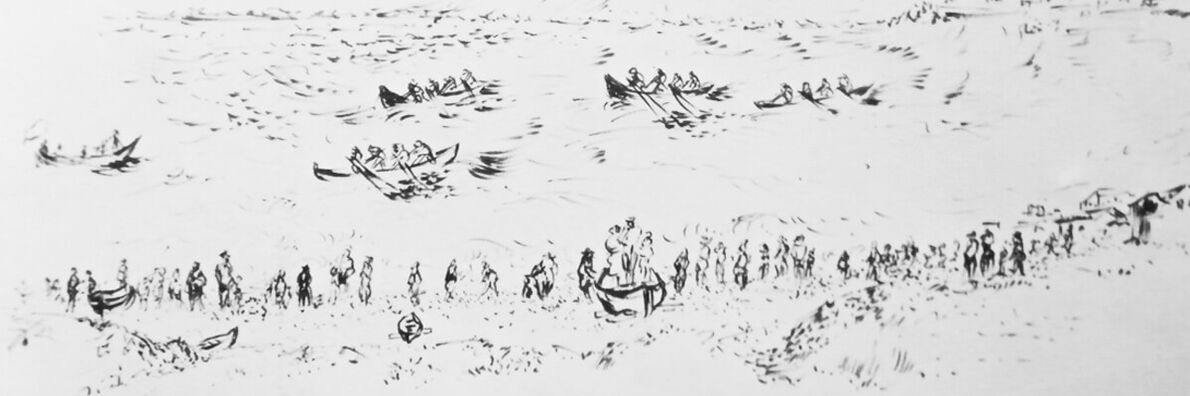
Fig. above: Giovanni Omiccioli: Competition among Fishermen, Scilla 1950 (detail), source: Fondazione Omiccioli – Archivio