Resources of the Future: Energy Sources and Science Elites in Late and Post-Soviet Science Fiction and Popular Scientific Publications
The project is part of the DFG research group “Energy Entanglements. Actors, Spaces and Narratives in Eastern Europe.” Within this group, researchers from Freie Universität Berlin, Humboldt-Universität zu Berlin, the Centre Marc Bloch, and the ZfL are jointly investigating the following questions: In what ways are the extraction and circulation of energies and the redesign of resource spaces intertwined? What formal and informal networks shape energy environments, and how do human and non-human actors influence them? Which concepts, topoi, and ideas shape discourses around energy? To explore these complex issues, the interdisciplinary group fosters a close collaboration between literary and cultural studies, political science, historiography, sociology, and economic sciences.
The ZfL subproject analyzes how science fiction texts and popular science journalism in the late Soviet Union and during the first two post-Soviet decades depict the future extraction of existing and yet-to-be-discovered energy resources as a solution to sociopolitical, ecological, and social issues. In this context, the project will explore the role of scientific-technical intelligence, particularly in the energy sector.
In order to reconstruct these interrelations, the subproject will address the following key questions:
- What immediate and long-term goals have been established in science fiction and journalism regarding the exploration, extraction, and utilization of energy resources?
- In light of threatening or even disastrous developments in the exploitation of resources, what utopian models of society, ecological perspectives on the future, and alternative paths of development does science fiction literature offer? What role do scientific elites play in initiating and/or solving these scenarios?
- How are popular scientific and fantastical scenarios interrelated, and how have they changed over time? Are there any convergences or divergences, and how do they relate to real historical developments of that time?
By answering these key questions, the subproject aims to contribute to the understanding of the ideological and imaginary expectations connected to the use of energy and large-scale energy infrastructure projects. At the same time, it demonstrates howthe belief in progress and expectations of catastrophe continued to shape respective discourses and debates on the treatment of the closely intertwined energy networks of the post-Soviet territory long after the collapse of the Soviet Union.
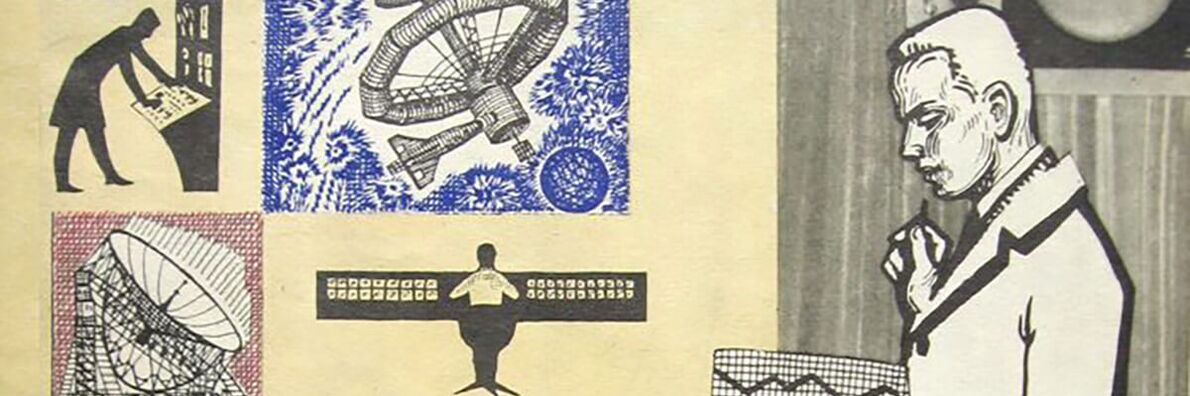
Fig. above: Detail from the cover image of the Soviet popular science magazine Znanie – sila (Knowledge Is Power) 5 (1965), design by Max Sherebchevsky